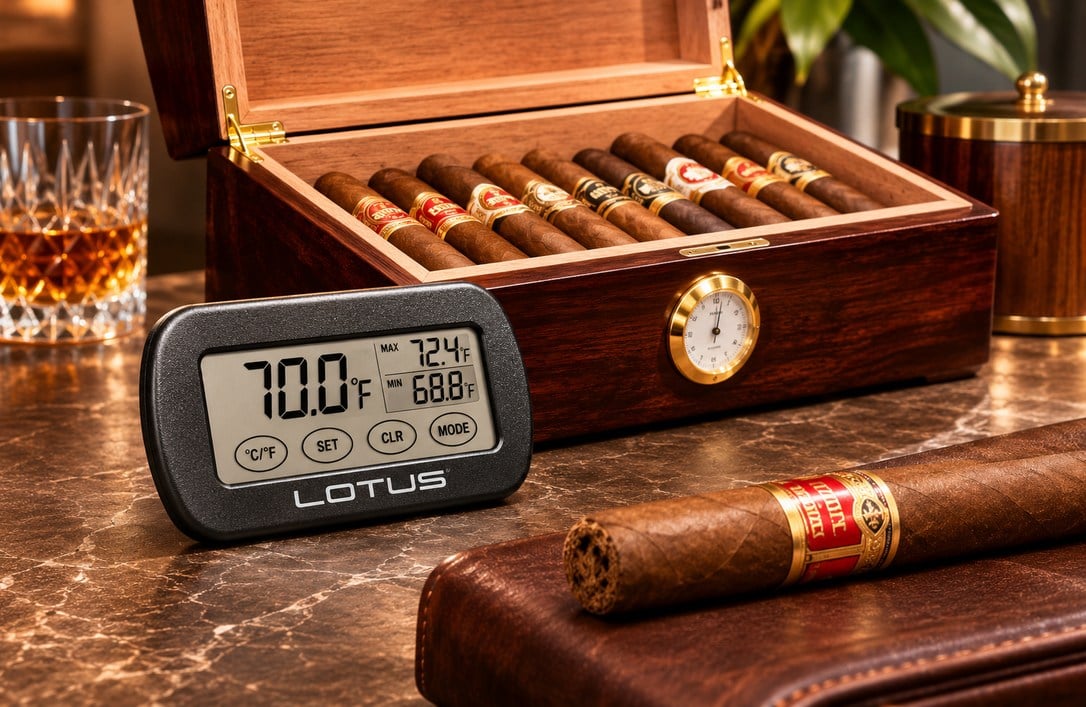
The 135 Rule for Cigar Humidity (And Why 70/70 Isn’t Quite Right)
Cigar 101 · Storage
You check the humidity in your humidor. Be honest — when did you last check the temperature? If the answer is “never,” you are following half a rule, and it is the half that lets tobacco beetles hatch.
Most people learn one thing about cigar storage: seventy and seventy. Seventy degrees, seventy percent humidity. It is easy to remember, it is printed on half the humidors ever sold, and it is close enough that it has kept a lot of cigars alive for a lot of years.
It is also the reason a lot of collections quietly go wrong. Because 70/70 treats temperature and humidity as two separate boxes to tick, when in reality they are two ends of the same lever. Move one, and the other has to move with it.
That is what the 135 rule fixes.
What the 135 rule actually says
The rule is one line of arithmetic. Add the temperature in Fahrenheit to the relative humidity, and aim for a total of 135.
Temperature °F + Relative Humidity % = 135
70°F + 65% • 68°F + 67% • 65°F + 70%
All three of those are correct. They are the same storage condition expressed at different room temperatures. A cigar kept at 65°F and 70% humidity and a cigar kept at 70°F and 65% humidity are, as far as the tobacco is concerned, in the same place.
Notice what the old rule does here. 70/70 adds up to 140. That is five points of slack, and it sits entirely on the warm, damp side of the target — which is precisely the direction you do not want to drift.
Why the two numbers are linked
This is not cigar mysticism. It is how air behaves.
Warm air holds more water vapour than cool air. Relative humidity measures how full the air is relative to what it could hold at that temperature. So 65% relative humidity at 70°F contains meaningfully more actual moisture than 65% at 60°F, even though the gauge reads the same number.
Your cigars do not respond to the percentage on the dial. They respond to the real moisture in the air around them. Which is why, as the temperature climbs, the humidity reading has to come down to keep the tobacco in the same condition — and why a single fixed humidity target cannot be right at every temperature.
The 135 rule is simply that relationship, compressed into something you can do in your head while standing in front of the humidor.
What goes wrong when the total runs high
Drift above 135 and two things start working against you, both of them temperature-driven.
Tobacco beetles. Lasioderma serricorne eggs can lie dormant in perfectly good tobacco for a long time. Push past roughly 72°F with high humidity and they hatch. You will find the evidence as small round exit holes in the wrapper and fine dust in the bottom of the box, and by then the beetles have usually visited more than one cigar. Temperature is the trigger. You can have flawless humidity and still lose a shelf to this.
Mould. Sustained humidity much above 72% starts growing things. Blue-green, fuzzy, raised off the wrapper — that is mould, and it is not the white crystalline plume that collectors prize. Warm and damp together get you there far faster than damp alone.
Run below 135 and the failure is slower and quieter: the cigars dry from the inside out, the oils that carry the flavour go with the moisture, and the burn turns hot and sharp. Nothing looks wrong. The cigar just stops being good.
The honest version: you have more tolerance than the internet suggests. A couple of points either side of 135 is fine. What matters is the direction and the duration — a weekend at 140 is nothing, a whole summer at 145 is how collections get ruined.
You cannot run this rule with a hygrometer alone
Here is the practical problem. The 135 rule needs two numbers, and almost every humidor on earth ships with an instrument that measures one.
If your humidor has a round dial in the lid reading 68%, you know one half of the equation. You do not know whether you are at 68°F and sitting pretty on 136, or at 76°F and sitting on 144 with the beetle window wide open. Same gauge, same reading, completely different situation.
This is the single cheapest fix in cigar storage, and it is why we would point you at one product before any other on this page.
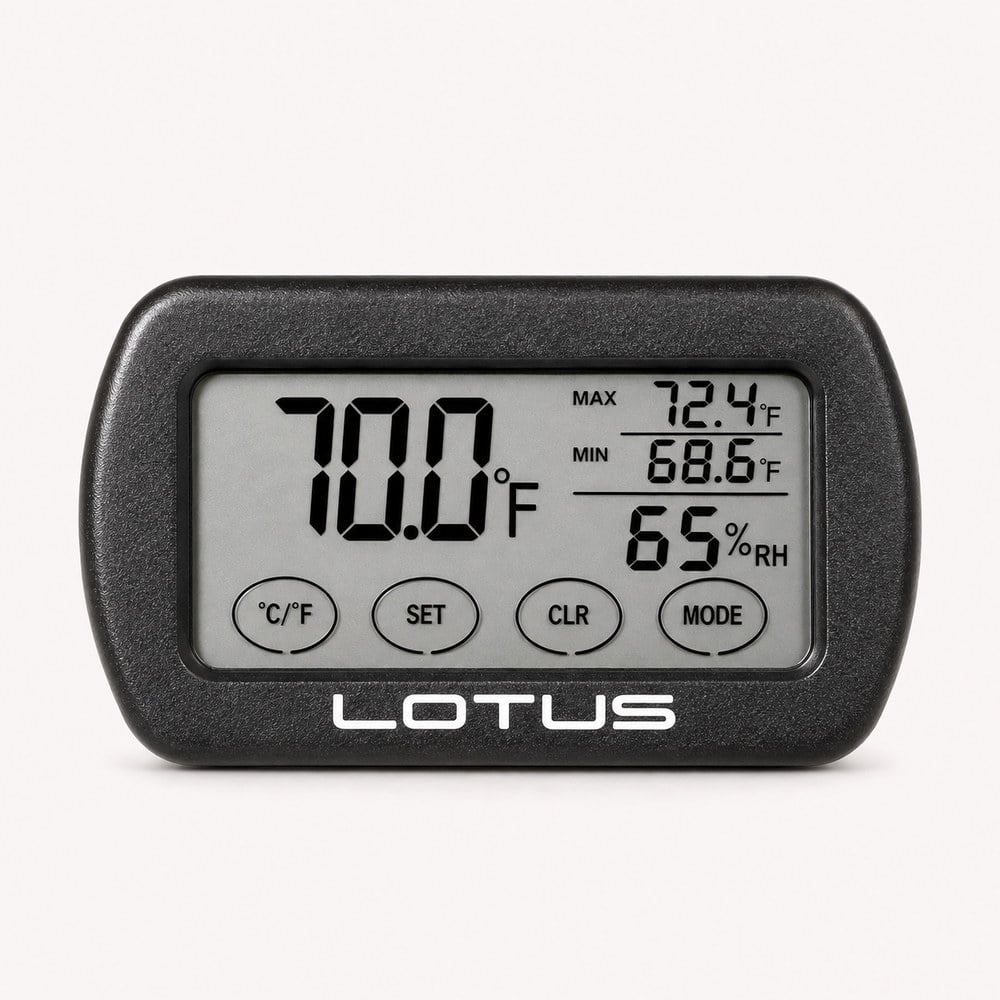
Lotus Digital Hygrometer and Thermometer
from $26.95
One small unit, both numbers, no arithmetic required beyond adding them together. It reads humidity and temperature on the same display, which means you can actually apply the 135 rule rather than guess at it. If you own a humidor and nothing else on this page, own this.
If you want to spend less, or more
A basic analog gauge will tell you something is wrong, eventually. A calibratable digital will tell you the truth. The difference matters more than the price gap suggests.
Before you trust any gauge, calibrate it. A new hygrometer being off by five or six points straight out of the box is completely normal, and five points is the difference between 135 and 141. We walk through the salt test, along with everything about setting your humidity target, in what RH should my humidor be.
Where you put the humidor is your temperature control
Humidity you can fix with a five-dollar pouch. Temperature you mostly fix by choosing a better shelf — and this is where the 135 rule quietly becomes useful, because it tells you that moving the humidor is a legitimate alternative to fiddling with the humidification.
- Interior walls, not exterior ones. An outside wall tracks the weather. An inside wall tracks your thermostat.
- Out of direct sun. A few hours of afternoon light through a window will push a closed box well past 80°F, and glass-top humidors are the worst offenders.
- Away from vents, radiators and electronics. The top of a cabinet above a television is one of the most common bad spots we hear about. Heat rises, and that is a warm shelf all evening.
- Not the attic, garage, basement or car. These swing hardest and fastest. Rapid temperature change is what cracks wrappers and pops box seams.
- Floor level beats eye level in a warm room. There can be several degrees between the top and bottom of the same wall.
Before you buy anything to solve a temperature problem, try moving the humidor and waiting two days. It is free, and it works more often than people expect.
When the room simply will not cooperate
Some rooms cannot hold 70°F. If you live somewhere genuinely hot, or you are storing a collection worth protecting properly, the answer is not more humidification — it is actual temperature control.
A cooler humidor is a sealed, insulated, cooled cabinet built for tobacco rather than for drinks. It holds the temperature half of the equation steady so the humidity half stops moving around on you. For a large collection in a warm climate, it is the only thing that genuinely solves the problem.
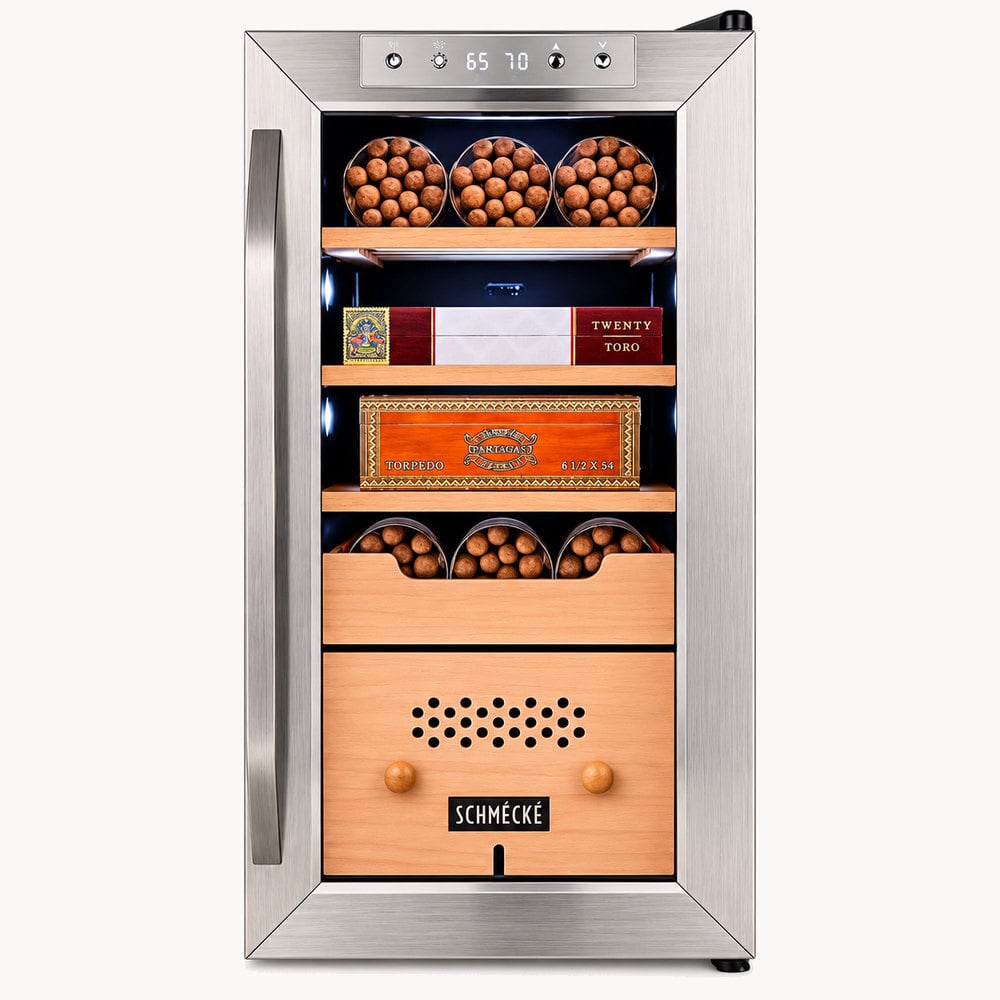
Cigar Cooler Humidors
from $799.95
Available in 250, 300 and 400 cigar capacities. If your collection has outgrown a desktop box, or your house simply runs warm, this is the step that takes the temperature variable off the table for good.
And if you are still choosing a humidor
Buy one with an external hygrometer if you can — being able to read the numbers without opening the lid means you will actually check them, and every time you open a humidor you reset its internal climate.
Holding the humidity half
Once the temperature is settled, the humidity side is straightforward. Pick the number that gets you to 135 and hold it there.
Two-way humidity pouches are the easiest option for most people — they add moisture when the box is dry and absorb it when the box is damp, so they forgive a certain amount of neglect. Crystal gel jars hold more and last longer in a bigger humidor. Distilled water or a proper humidification solution only, never tap water, which brings minerals and the occasional unwelcome organism with it.
What the seasons do to your total
The 135 rule is most useful twice a year, when the house changes and the humidor has not caught up yet.
| Season | What the house does | What your total does | The adjustment |
|---|---|---|---|
| Winter | Central heating dries the air hard | Falls below 135 | Recharge pouches more often, check weekly, expect to top up humidification |
| Summer | Warm rooms, humid air, AC cycling | Climbs above 135 | Move the humidor cooler, ease off the humidification, watch for beetles |
| Spring / autumn | Wide day-to-night temperature swings | Hovers near 135 | Leave it alone, check fortnightly |
The instinct in winter is to add humidification until the gauge reads 70% again. Check the temperature first. If the room has dropped to 64°F, then 70% humidity puts you at 134 — you are already where you want to be, and adding moisture would take you the wrong way.
The quick version
The 135 rule, in six lines
- Add temperature in °F to relative humidity. Aim for 135.
- 70/65, 68/67 and 65/70 are all the same correct answer.
- Above 72°F is beetle territory. Above 72% is mould territory.
- Buy a gauge that reads both numbers, then calibrate it.
- Fix temperature by moving the humidor before you buy anything.
- A few points either side is fine. Months on the wrong side is not.
None of this needs to be fussy. Check the two numbers once a week, add them together, and if the total is somewhere near 135 you can stop thinking about it and go and smoke something. That is rather the point of getting the storage right — it is supposed to stop being a hobby of its own.
Earn while you stock up
Every order at Mike’s Cigars earns Reward Points you can put straight towards your next box — accessories included. And if you would rather have something new arrive without thinking about it, our Cigar of the Month Club does exactly that.
Questions about your own setup? Call us on 1-800-962-4427. We have been doing this since 1950, and we have heard every humidor problem there is.